SEO Strategy / 2026 Guide
Programmatic SEO Examples: 8 Models That Create Real Value
A practical teardown of how real platforms turn structured data into helpful search pages—and how smaller teams can adapt the model without flooding Google with thin content.
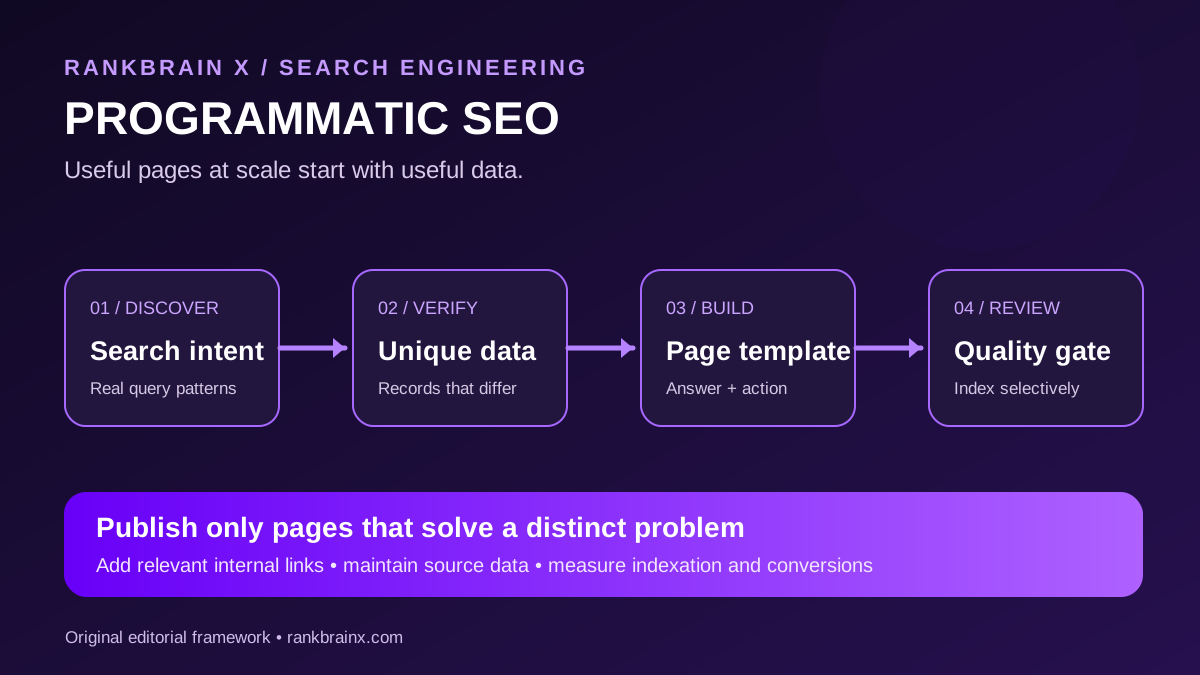
The short answer
Programmatic SEO is a method of publishing repeatable, search-focused pages using structured data and reusable layouts. Successful implementations do more than swap a keyword in a heading: each page offers an answer, inventory, calculation, comparison, or tool that is genuinely specific to its query.
Think of Zapier's app connections, Wise's currency conversion utilities, Canva's design galleries, and Tripadvisor's destination lists. These are observable product patterns—not audited claims about each company's private ranking algorithms, conversion rates, or traffic volumes.
The RankBrain X filter
If you remove the city, app, product, or entity name, does the page still contain distinct and useful information? If not, improve the dataset before scaling the template.
8 real-world programmatic SEO patterns worth studying
The examples below describe visible patterns and potential lessons, not claims of exclusive insider knowledge. Visit the linked websites to see how their catalogs and tools are organized.
1. Zapier
View live example ↗[App A] + [App B] integration
- What changes by URL
- Supported triggers, actions, and usable automation templates for each real integration pair.
- Search need addressed
- Connect two specific applications and build a working workflow.
Takeaway: Let genuine product functionality determine which combinations deserve URLs.
2. Wise
View live example ↗[Currency A] to [Currency B]
- What changes by URL
- Currency-specific rate information, conversion tools, and payment context.
- Search need addressed
- Convert a particular currency pair or understand transfer options.
Takeaway: A working utility with reliable inputs is worth more than interchangeable explanatory copy.
3. Tripadvisor
View live example ↗[Category] in [Destination]
- What changes by URL
- Actual listings, local reviews, photos, and location-specific travel information.
- Search need addressed
- Compare relevant places for a specific destination.
Takeaway: Parent destinations, categories, and real listings make the taxonomy useful.
4. Canva
View live example ↗[Use case] + [Design type]
- What changes by URL
- Editable design assets, visual previews, and template categories.
- Search need addressed
- Find a usable design, not merely read about a design category.
Takeaway: Put the practical output—templates and previews—before long editorial introductions.
5. G2
View live example ↗[Software category] / [Product] alternatives
- What changes by URL
- Software listings and user-contributed review and comparison information.
- Search need addressed
- Shortlist or compare software for a defined problem.
Takeaway: Comparisons require differentiated attributes and transparent evaluation criteria.
6. Glassdoor
View live example ↗[Role] + [Employer] salary or interview
- What changes by URL
- Role- and employer-specific community submissions and compensation context.
- Search need addressed
- Research a workplace, role, interview, or compensation range.
Takeaway: User-submitted data must be contextualized; thin combinations are not automatically valuable.
7. Zillow
View live example ↗[Property type] + [Location]
- What changes by URL
- Available property listings and geographic attributes.
- Search need addressed
- Browse real housing inventory in a particular market.
Takeaway: Only publish location/filter pages with substantial real inventory or distinct local value.
8. Nomads.com
View live example ↗[City] + [Remote-work attribute]
- What changes by URL
- City-level cost, climate, connectivity, and community-oriented information.
- Search need addressed
- Assess whether a city suits remote work.
Takeaway: Consistent comparison dimensions make many location pages valuable without copying descriptions.
A different playbook for smaller sites and local businesses
Enterprise directories are built around enormous data assets. A smaller company should start with reliable coverage, not a giant URL count. Consider a home services company offering tree removal, stump grinding, and emergency storm cleanup across several cities.
| Potential page | Evidence needed | Decision |
|---|---|---|
| Tree removal in a served city | Real coverage, local projects, permits or constraints, photos, FAQs | Publish if substantively useful |
| Emergency tree service in every ZIP code | Distinct service proof and actual availability | Avoid mass thin permutations |
| Stump grinding cost by service area | Documented cost drivers, local conditions, pricing methodology | Publish where credible data exists |
Use RankBrain X to organize SEO review workflows, and explore the available SEO platform plans before deciding which tools fit your process. Programmatic page publishing itself is not promised as an automated RankBrain X feature.
How to build a quality-first programmatic SEO system
This editorial workflow combines technical safeguards with content usefulness. It is a practical planning framework, not a guaranteed Google ranking formula.
- 1
Model keyword families
Group search queries by repeatable intent, such as service + city, software + integration, or product + feature. Separate genuinely distinct needs from near-duplicates.
- 2
Audit your data source
Require verified records, provenance, update frequency, and enough useful variation for every proposed URL. Do not manufacture facts to fill templates.
- 3
Create a page-value threshold
For each URL, ask whether it offers a unique answer, working tool, available inventory, real comparison, or credible local evidence. Pages that fail should not be indexed.
- 4
Build a semantic template
Render a descriptive title, a single clear H1, helpful main content, contextual links, breadcrumbs where appropriate, accessible imagery, and a task-focused CTA.
- 5
Control URL permutations
Use canonicals consistently, avoid indexable empty filters, and keep query-parameter sort orders from generating duplicative indexable pages.
- 6
Connect the internal link graph
Link category hubs to relevant leaf pages and leaf pages to helpful parents, siblings, and next steps. Avoid orphan URLs.
- 7
Launch a small verified pilot
Publish a manageable subset first, validate rendering and structured data, and inspect canonical selection and indexation before scaling.
- 8
Measure outcomes beyond index count
Monitor indexed URLs, impressions, engagement, qualified conversions, data freshness, and maintenance costs. Retire pages that no longer help users.
An internal linking blueprint search engines and users can follow
A well-structured directory starts from a navigable hub. For example, an integration catalog can link Integrations → Google Sheets integrations → Slack to Google Sheets, then point users back to the parent category and to genuinely related workflows. Local SEO pages can follow Services → Tree Removal → Tree Removal in Austin, linking to neighboring services only when useful.
Keep descriptive anchor text, XML sitemaps with preferred URLs, and canonical tags aligned. A sitemap helps discovery; it does not force Google to index every page. See Google's sitemap guidance and Search Essentials.
Common mistakes that undermine scale
- City-name swaps: publishing near-identical pages with no credible local details.
- Empty result pages: allowing every filter or combination to be indexed even when no inventory exists.
- Unverified AI copy: generating service claims, quotes, reviews, prices, or statistics without an underlying source.
- Disconnected URLs: relying only on a sitemap instead of accessible, contextual internal links.
- No data lifecycle: leaving old inventory, fees, availability, or business facts unchanged.
- Vanity KPIs: celebrating page count without measuring qualified traffic and user actions.
Google explicitly warns against scaled content created primarily for ranking manipulation rather than user benefit. Read the scaled content abuse policy before building thousands of URLs.
What to measure in Google Search Console
Use cohorts by template, topic, and release date. Review page discovery, canonical selection, excluded URLs, query impressions, clicks, and pages receiving meaningful engagement. Tie organic visits to useful outcomes such as a tool completion, lead, booking, or signup. Compare your pilot with a reasonable baseline and look for content drift over time.
Do not confuse indexed with successful. A URL can be indexed yet provide no value; a helpful new page may take time to be crawled and evaluated.
Frequently asked questions
Is programmatic SEO the same as AI-generated content? +
No. Programmatic SEO uses structured data and reusable templates to serve many distinct search needs. AI can help draft or analyze pages, but it is not required and does not replace unique source data.
Does Google penalize programmatic SEO? +
Google does not prohibit templates or automation as such. Its scaled content abuse policy targets large amounts of low-value content created mainly to manipulate rankings, regardless of how the content was produced.
How many pages should I publish first? +
There is no universal count. Start with a set small enough to review manually, validate its data and indexation, then expand only when the template consistently delivers distinct value.
Should every filter combination be indexable? +
No. Index only useful combinations with enough content or inventory and clear search intent. Sorting, empty results, and trivial variations usually need more restrictive handling.
Can local service companies use programmatic SEO? +
Yes, when each service-area page is substantively different and accurate—such as real service coverage, project evidence, local restrictions, photos, service details, and genuine customer questions. Changing the city name alone is not enough.
Sources, editorial method, and transparency
Prepared by the RankBrain X Editorial Team as an educational comparison of publicly observable page patterns. This guide draws on public product examples, Search Atlas's enterprise architecture overview, Zapier's own explanation, and Google's people-first content guidance. The structure, commentary, checklist, and illustration are original to this article.
This article was prepared with AI assistance and source review. We have not audited these companies' private analytics, traffic counts, or internal databases. No rankings or commercial results are guaranteed. Editorial correction requests can be submitted through the RankBrain X website.
First published: . Examples and website features may change after publication.
From ideas to implementation
Audit your pages before you scale them.
Turn a raw page inventory into prioritized SEO opportunities. Start by reviewing technical health, content gaps, and search performance—then keep human judgment in the loop.
Feature availability varies by plan and development status. SEO outcomes are not guaranteed.